A barrel sauna is an outdoor sauna made from curved wooden staves held by steel bands. Its small round interior heats quickly with a modest heater. Here is how to size one, choose between wood and electric heat, and keep it working through a Canadian winter.
By Daniel. Published October 21, 2026. 5 min read.
The short answer
A barrel sauna is an outdoor sauna built from curved staves held by steel bands, usually in cedar or thermally modified wood. The round shape gives a small interior volume, so it heats quickly with a modest heater. Most two- to four-person barrels use an electric heater of about 4.5 to 8 kW or a compact wood stove. In cold climates, plan for a slightly larger heater, because the walls are solid wood without added insulation.
Why the barrel shape
Less air to heat. The curved roof removes the unused corners of a square room.
Good circulation. Hot air rolls along the curved ceiling and back down over the benches.
Simple to build. Staves slot together and the bands pull them tight, which is why barrels are popular as kits.
Strong look. A barrel in a backyard or by a lake is a design feature in itself.
The trade-offs: headroom is lower at the sides, the wall wood is also the insulation, and the staves move with humidity, so the bands need occasional adjustment.
Sizes
Capacity
Typical length
Typical electric heater
Good for
2 people
About 4 to 5 ft
About 3 to 4.5 kW
Couples, small yards
4 people
About 6 ft
About 4.5 to 6 kW
Most families
6 people
About 7 to 8 ft
About 6 to 9 kW
Larger families, guests
With changing room
Longer barrel with a partition
Sized for the hot room only
Winter use, privacy
These are typical ranges. Use the barrel maker's recommended heater or run the inside dimensions through the sauna heater size calculator, choosing the log wall option because barrel walls are solid wood.
Choosing the heater
Barrel saunas are sold with a heater or ready for one. Points to check:
Clearances. The curved walls come closer to a heater than flat walls, so follow the heater manual's clearances exactly, and use the guard and heat shield it calls for.
Stone load. A heater with more stones gives softer steam and holds heat after the barrel door opens, which matters in a small room.
Outdoor rating for controls. Keep electronic controls inside a dry changing room or the house, or use controls rated for the location.
Harvia owns the US barrel maker Almost Heaven, and Canadian sauna stores such as LeisureCraft in Ontario sell cedar barrels. Heater makers are compared in the sauna heater brand comparison.
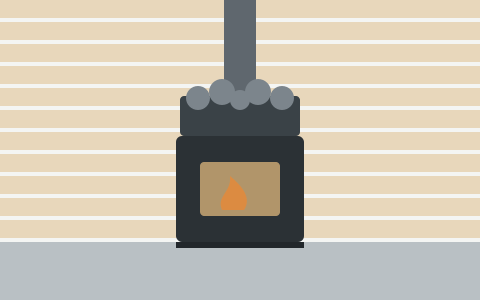
Compact wood stoves are a popular choice for barrel saunas away from the house.
Wood or electric in a barrel
An electric heater makes sense when the barrel sits near the house and you can run a buried, properly protected 240 V supply to it. It starts from a timer or app and needs no chimney. A wood stove suits a barrel at the back of a large lot, at a cottage or anywhere a cable run would be long and costly. It needs a chimney kit with a roof flashing made for the barrel's curve, and you should check local rules on outdoor wood burning. The full comparison is in electric vs wood-burning sauna heaters.
Barrel saunas in a Canadian winter
Barrels work in winter, but a cold barrel takes longer to heat. To make it easier:
Choose a heater toward the upper end of the recommended range.
Pick a model with a small changing room, so the hot room door opens into a sheltered space.
Keep the door seal in good shape and add a vent you can close partly.
Clear snow off the roof and keep the path and door free of ice.
Set the barrel on a level, well-drained base: concrete pads, a gravel bed with pavers or a deck rated for the weight, with the cradles fully supported.
Keep air moving under it so the bottom staves dry out.
Protect the top. Many owners add a roof membrane, shingles or a separate roof over the barrel to keep rain and sun off the staves.
Check permits. Some municipalities treat a barrel sauna as an accessory building, and any 240 V supply or wood stove usually needs a permit.
Kit or DIY
Most barrels are bought as kits with pre-cut staves, bands, door and benches, and two people can assemble one in a day or two. Building from scratch is possible if you can mill accurate tongue-and-groove staves, but the time saved by a kit is usually worth it. Either way, the heater install and any wiring or chimney work follow the same rules as any sauna; see how to build a home sauna.
Care and upkeep
Check and adjust the steel bands each season as the wood swells and shrinks.
Treat the exterior with a product for outdoor wood; leave the inside unfinished.
Leave the door and vents open after use so the interior dries.
Inspect the stones and heater yearly, and the chimney if you burn wood.
Typically about 3 to 4.5 kW for a two-person barrel, 4.5 to 6 kW for four people and 6 to 9 kW for six. Use the barrel maker's recommendation and size up slightly for cold climates.
Is a wood stove or electric heater better for a barrel sauna?
Electric suits barrels near the house with a 240 V supply run to them. A wood stove suits barrels far from power or at a cottage, but needs a chimney kit for the curved roof and may need a permit.
Can you use a barrel sauna in winter?
Yes. Allow longer to heat up, choose a heater at the top of the recommended range, and a model with a changing room helps.
Do barrel saunas need a foundation?
They need a level, well-drained base that supports the cradles, such as concrete pads, a gravel bed with pavers or a strong deck, with air able to move underneath.
Last checked November 8, 2026. Facts come from the brands' own sites and documents. How we check